Box Dimensioning with Computer Vision: One Camera, Every Dimension
Vision-based box dimensioning uses a depth camera and a neural network to measure length, width, height, and volume, instead of a certified dimensioning appliance with its own light curtain and controller. Everything runs on-board the camera. Each box in the frame produces one result, with a preview image attached so you can check the read and offload the images.
Dedicated dimensioners work. The problem is what they cost and how little else they do. Our Box Dimensioning solution runs on an OAK 4 for roughly one-tenth the price of a dedicated appliance, which changes the question from "where do we put the dimensioner" to "which points on the line do we want measured." This cost question is very important, because not only does that OAK 4 device do your dimensioning, it can also read your barcodes and run various other models in the same pipeline.
Your station for dimensioning is no longer “boxed” into just that. Using our industry leading edge capabilities, combining neural inference, stereo depth and real-time vision on a single unit.
How does camera-based box dimensioning work?
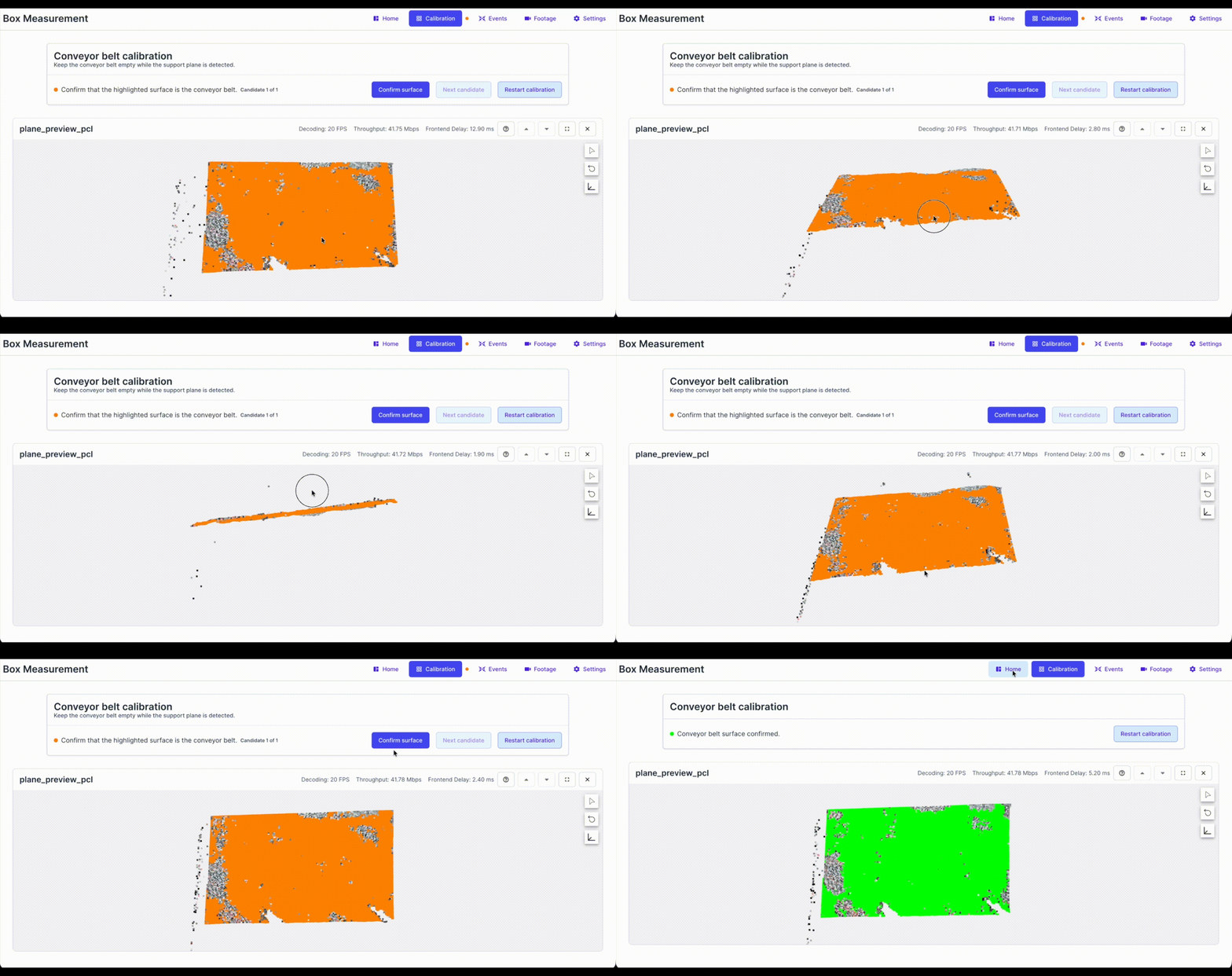
Calibration comes first. You calibrate the ground plane once, and height gets measured against real-world values from that reference. After that, a neural network segments each box against the calibrated plane and tracks it through the frame, so one unique box yields one result. No duplicate reads to reconcile downstream, even if there are multiple boxes in the field of view.
Depth is where the flexibility lives. Stereo matching runs at up to 120 FPS for ultra-low latency on moving belts, neural-assisted stereo handles surfaces plain stereo struggles with, and time-of-flight gives laser-accurate, consistent depth at short range on the models that support it. Same camera, but instead, you pick the method that matches the station rather than buying a different appliance for each one.
Mounting is top-down or angled. Detection, depth, and measurement all run as on-device edge inference, so there is no dependency on Wi-Fi or a backend to get a number. No server, no streaming pipeline. Your only recurring cost is power, at roughly $10 a year, which is a fraction of typical cloud service bills.
Top Down
Angled
The cost math
Dedicated Dimensioner
- Expensive appliances, only fit for one task
- Often needs vendor assistance for new product variety
- Separate hardware for other vision tasks
OAK 4 Vision System
- Roughly 1/10th the cost.
- Only retrain your detection model when new products get mixed in
- Same DepthAI pipeline you use for barcode reading, QA, etc.
The cost of per-station pricing is what keeps most lines down to a single measurement point that can sometimes bottleneck your operations*. When a camera costs a tenth of an appliance, measuring at receiving, at pack-out, and at the outbound belt stops being a capital request. The best part? That same unit that is measuring at those locations, can also decode the barcodes.*
Reviewable results
Every measurement comes with a preview image, and clips are available for the reads you want to inspect. When a number looks wrong, you can look at the actual box that produced it instead of arguing with a log file. Devices are PoE-ready, IP67 for the tough environments, and incredibly modular to ensure you get the right camera, every time.
Where it gets used
Conveyor dimensioning and measurement at line speed is the obvious one. Beyond that: bin picking, palletizing and depalletizing, inventory and storage planning, damage and fit inspection, and running barcode or label reading in the same pipeline so a package is measured and identified at the same station.
FAQ
How accurate is camera-based dimensioning? Accuracy depends on the depth method and working distance. Stereo covers most conveyor cases, and time-of-flight gives consistent, laser-accurate depth at short range. We size the configuration against your box mix during a demo rather than quoting one number for every case.
Is it legal-for-trade certified? No. This is operational measurement for cubing, planning, and inspection, not certified billing. If you need certified weights and dimensions for tariffs, keep the certified device at that one point and use cameras everywhere else.
Does it handle boxes at different orientations? Yes. The detection model segments boxes against the calibrated plane rather than assuming a fixed pose, and it handles varying sizes, belt speeds, and lighting.
Can it read barcodes at the same time? Yes. Box Dimensioning runs alongside custom DepthAI pipelines, including multi-code barcode and label reading at line speed.
What happens if the product mix changes? The detection model can be retrained for different products, so a new packaging format is a model update rather than a vendor visit.
Does it need cloud or Wi-Fi? No. Detection, depth, and measurement all run on the camera. Enabled by the OAK 4's 52 TOPS of on-device inferencing power. No need for a host PC to achieve all your inspections in one place.
See it on your boxes
Book a demo to determine how this works with your actual box mix, including the awkward ones: crushed corners, black shrink wrap, odd aspect ratios. Those decide whether a system works on your line. Our sales team is piloting this application for users now. Book here to learn more and get started!