As the marine industry shifts from human divers, who are bound by strict physical limits like depth, air consumption and decompression times, toward Remotely Operated Vehicles (ROVs), these underwater robots need highly accurate "eyes" to understand their environment.
Enter MarineSitu, a pioneering marine technology company dedicated to making underwater surveying more efficient and accessible. By leveraging Luxonis stereo vision technology, MarineSitu has developed the C3 Stereo Camera; a rugged, high-resolution solution that is changing how researchers, conservationists, and the aquaculture industry monitor marine habitats.
The Challenge: The Limits of 2D Vision
To create accurate 3D reconstructions of benthic habitats (the ecological region at the lowest level of a body of water), marine scientists use a technique called structure-from-motion photogrammetry.
Historically, doing this required human divers to physically place "scale bars" on the ocean floor before swimming a survey pattern and taking photos, providing a size reference so the images could be accurately scaled into a 3D model later. This manual process is incredibly slow, severely limiting the size of the areas that can be mapped.
Standard 2D cameras on ROVs couldn't solve this problem alone, as they lack the depth perception required to mathematically recreate the physical environment at scale. MarineSitu needed a robust stereo vision solution that could survive underwater, easily integrate into their existing SaltySuite™software stack, and deliver pristine data.
Why MarineSitu Chose Luxonis
To bring their vision to life, MarineSitu developed the C3 Stereo Camera, utilizing the Luxonis OAK-D W PoE as its core sensor. Custom-built into a rugged underwater housing, the C3 camera handles both ROV integration and stationary monitoring deployments.
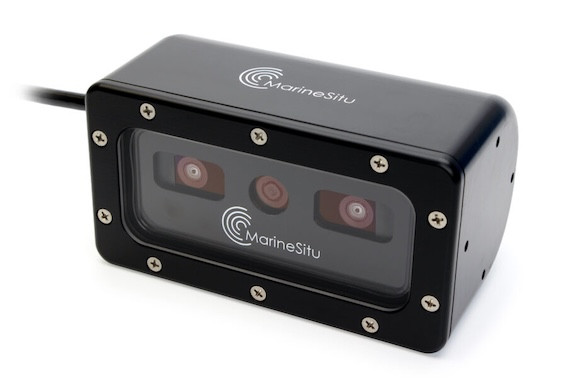
Building hardware for the harsh marine environment is notoriously difficult. When MarineSitu set out to fulfill a grant proposal for a low-cost ROV stereo camera, Luxonis stood out as the right fit for a few critical reasons:
Reliable Image Quality & Depth: Underwater environments suffer from low visibility, variable lighting, and harsh conditions. The Luxonis OAK-D provides highly performant, high-resolution color imagery and reliable stereo depth mapping, ensuring that researchers get crisp, accurate spatial data even in tough subsea environments.
Compact Form Factor: The small footprint of the OAK architecture allowed MarineSitu to design a streamlined, hydrodynamic underwater housing that doesn't weigh down the ROV.
The Open SDK: Luxonis' open-source approach was a massive draw, allowing the MarineSitu engineering team to seamlessly integrate the camera into their own complex software platforms.
Cost-Effective Scaling: The accessible price point aligned perfectly with MarineSitu's goal of creating a low-cost, high-value surveying tool.
In-Water Calibration for Unmatched Accuracy
One of MarineSitu's standout strategic initiatives is their commitment to precision. Knowing that light refracts differently in water than in air, all C3 cameras (both ROV and standalone models) are rigorously calibrated in-water in MarineSitu's dedicated office calibration tank.
This crucial step is made possible by Luxonis's intuitive manual calibration process. By leveraging these calibration tools, MarineSitu can tune the cameras specifically for aquatic refraction, ensuring that the measurements and rectification for underwater deployments are highly accurate right out of the box.
Unlocking the Future with Edge AI
Furthermore, the OAK platform's ability to handle on-device AI inference is a major advantage for MarineSitu. The functionality to deploy custom machine learning models directly onto the camera itself opens the door for even smarter, more autonomous underwater cameras with next generations. By processing data at the edge, MarineSitu is well-positioned to increase performance, reduce bandwidth constraints, and enable advanced real-time marine life tracking in future deployments.
Seamless Software Integration
Hardware is only as good as the software that powers it. The open, highly flexible nature of the Luxonis DepthAI API was crucial to this project, empowering MarineSitu's engineers to seamlessly integrate the OAK camera into two distinct software environments:
SaltySuite™: MarineSitu’s proprietary platform for managing data across multiple underwater sensors, allowing users to automate processing using custom-trained AI/ML models.
Madrona: An open-source BlueOS extension that lets BlueROV2 users easily control the C3 camera and collect data natively.
Mangrove: MarineSitu’s proprietary edge software meant for configuring multiple underwater sensors, syncing data collection, and running powerful, custom ML models in real-time.
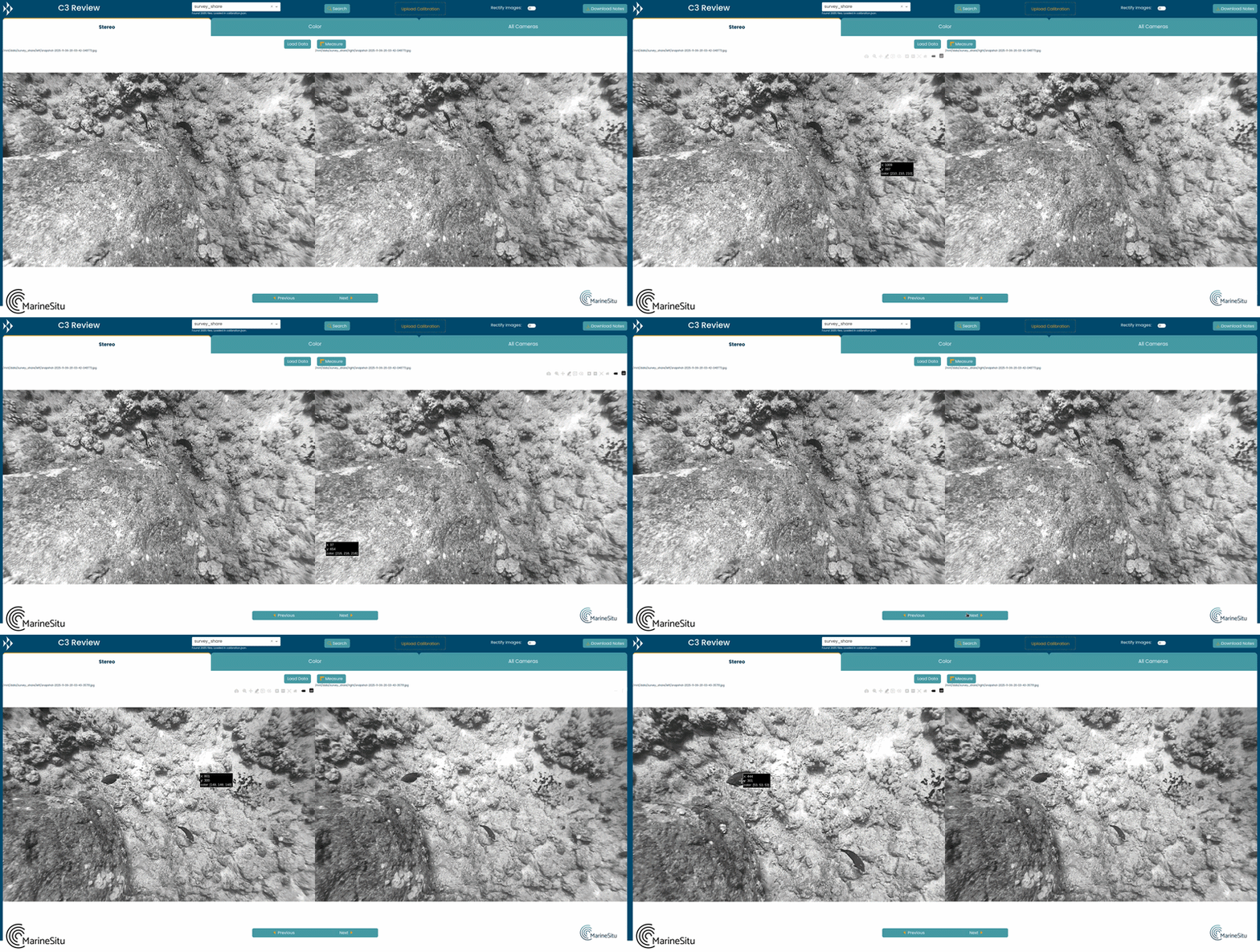
From Concept to Launch in Just 8 Months
Because Luxonis provided a stable hardware foundation and an open SDK, MarineSitu was able to move incredibly fast. From their initial exploration of the OAK ecosystem to the official launch of the first C3 product, the entire development timeline took approximately just eight months.
Making Waves with Blue Robotics
Through their strategic partnership with industry leader Blue Robotics, MarineSitu is bringing advanced stereo vision to marine professionals worldwide. The MarineSitu C3 Stereo Camera is now officially available on The Reef as an integrated upgrade for the BlueROV2 ecosystem.
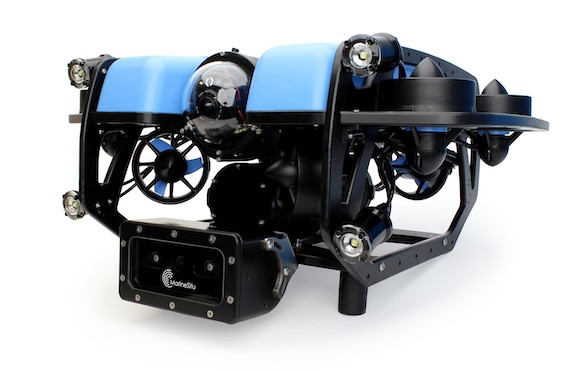
By combining Luxonis edge vision with MarineSitu's underwater engineering expertise, the C3 camera is unlocking a new era of ocean exploration making the protection and study of our marine environments more attainable than ever before.
Learn More & Get Started