We are excited to introduce the OAK Filter Addon Kit: a pair of quick and simple clip-on accessories designed to instantly improve your camera's depth perception in challenging lighting.
Built specifically for the OAK-D-S2 PoE and OAK4-D cameras, these polarized “glasses" easily clip onto the front of your device, so you can instantly test if filtering the light entering the imagers improves imaging quality for your use case.
What’s in the Kit?
We are offering the OAK Filter Add-on Kit in two specific SKUs (one for the OAK-D-S2 PoE and one for the OAK4-D). Because every environment is different, you don't have to guess which filter orientation you need before testing.
When you purchase a kit, it comes with two distinct attachments:
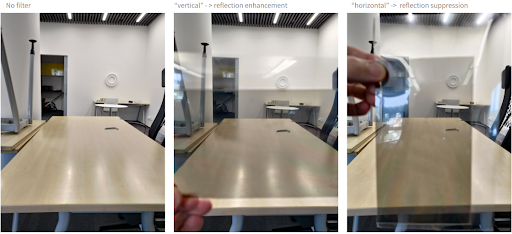
Horizontal Polarizer Glasses: To suppress horizontal reflections.
Vertical Polarizer Glasses: To suppress vertical reflections.
If you only want to test performance on the stereo pair and not the RGB (or vice versa), the filters are easily removable from the holders.
But why is filtering polarized light so critical for spatial AI in the first place? Let's dive into the physics of how reflections trick your camera, and how these glasses fix it.
Linear Polarizing Filters
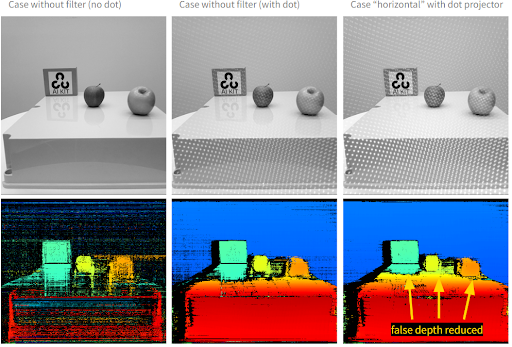
Reflected light poses a challenge for Z-depth algorithms, which misinterpret reflections as actual objects. This can lead to inaccurate depth readings, particularly on smooth, shiny surfaces such as floors, tabletops, or vehicles. These surfaces polarize reflected light, contributing to the issue.
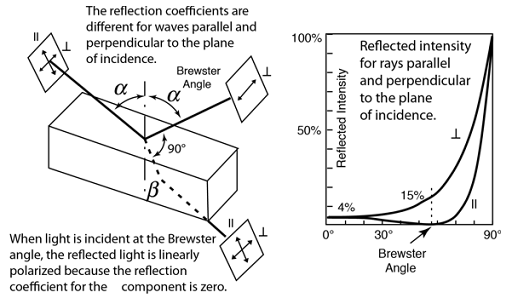
A polarizing filter adjusts reflection intensity by blocking polarized light, with its effect dependent on orientation.
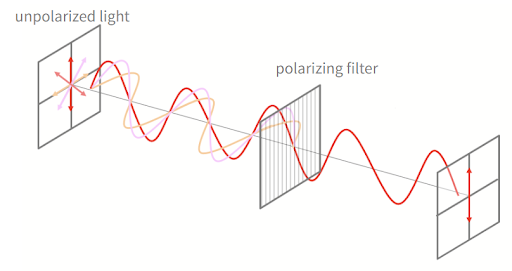
Why Orientation Matters
Direct Effect on Z-depth (with active stereo)
Linear polarizing filters are especially useful in depth camera systems for improving image quality and depth accuracy in challenging visual environments.
Glare Reduction:
Suppresses reflections from shiny surfaces (e.g. glass, water, metal). Enhances visibility of true surface features for better stereo matching.
Improved Texture Detection:
Increases contrast in low-texture scenes
Helps stereo algorithms detect disparities more reliably.
Surface Inspection:
Reveals surface defects like scratches or dents that are hidden under glare
Useful in quality control and industrial inspection
Shape-from-Polarization (SfP):
Enables estimation of surface normals and 3D shape from polarization cues
Adds depth information even in textureless or uniform areas
Outdoor and Harsh Lighting Conditions:
Minimizes the impact of polarized sunlight or reflections
Stabilizes image quality in variable lighting
Linear polarizing filters are especially useful in environments where surface reflections and glare interfere with visual perception and depth accuracy, particularly in scenes involving shiny materials or directional lighting.
Robotics: For navigation and manipulation in reflective or outdoor environments.
Manufacturing: Surface inspection and defect detection.
Agriculture: Crop monitoring and soil analysis under sunlight.
Automotive: Driver monitoring and ADAS systems.
Medical Imaging: Tissue visualization and surface mapping.
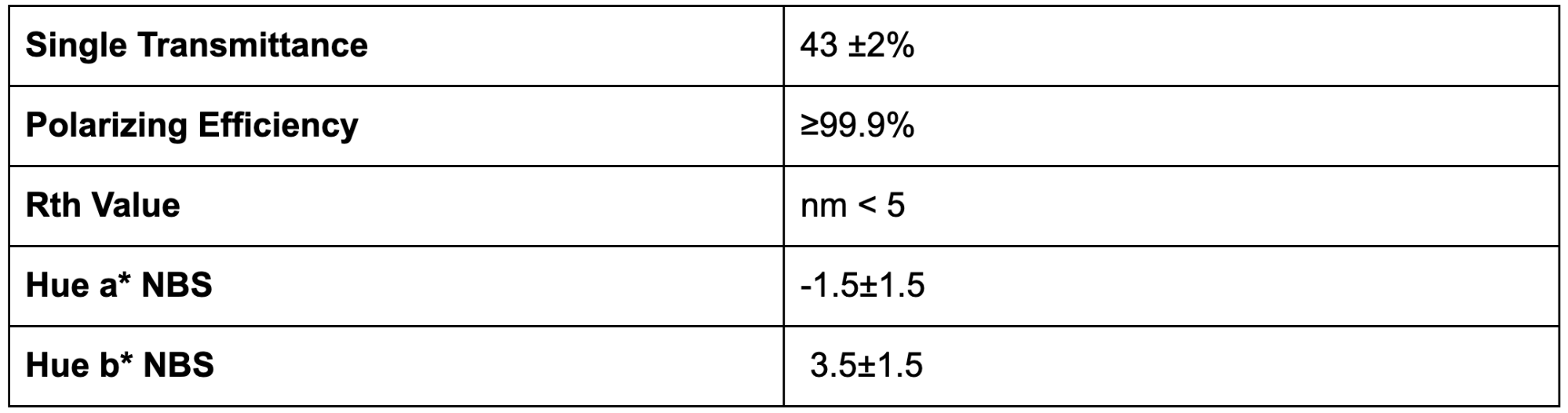
The Strategy: Validate Now, Integrate Later
Because these filters can drastically improve performance across many different industries and environments, we designed the OAK Filter Add-on Kit to be the ultimate prototyping tool.
If you are dealing with shiny floors, glass, metal parts, or harsh outdoor lighting, here is how you can use these kits to optimize your final product:
Test & Validate: Buy a kit and clip the glasses onto your evaluation cameras. Run your pipeline in your actual environment to see exactly how the horizontal or vertical filters impact your depth accuracy and texture detection.
Contact Us for Production: Once you have proven that a specific polarization orientation solves your environmental challenges, you don't need to buy hundreds of clip-on glasses for your final deployment.
Custom Manufacturing: If you are placing a large bulk order for your fleet, contact our team directly. We can take the exact improvements you observed and natively integrate that specific filter directly into the camera lenses during mass production.
You get the flexibility to experiment and prove your concept today, and the streamlined, custom hardware you need for scale tomorrow.
Ready to see things differently?