We’re excited to announce the official release of DepthAI v3.3.0! This update introduces powerful new debugging capabilities, hybrid depth fusion, expanded system metrics, and a range of improvements that make building and maintaining complex AI vision pipelines easier and more robust across both RVC2 and RVC4 devices.
What’s New in v3.3.0
🧩 Pipeline Debugging Support
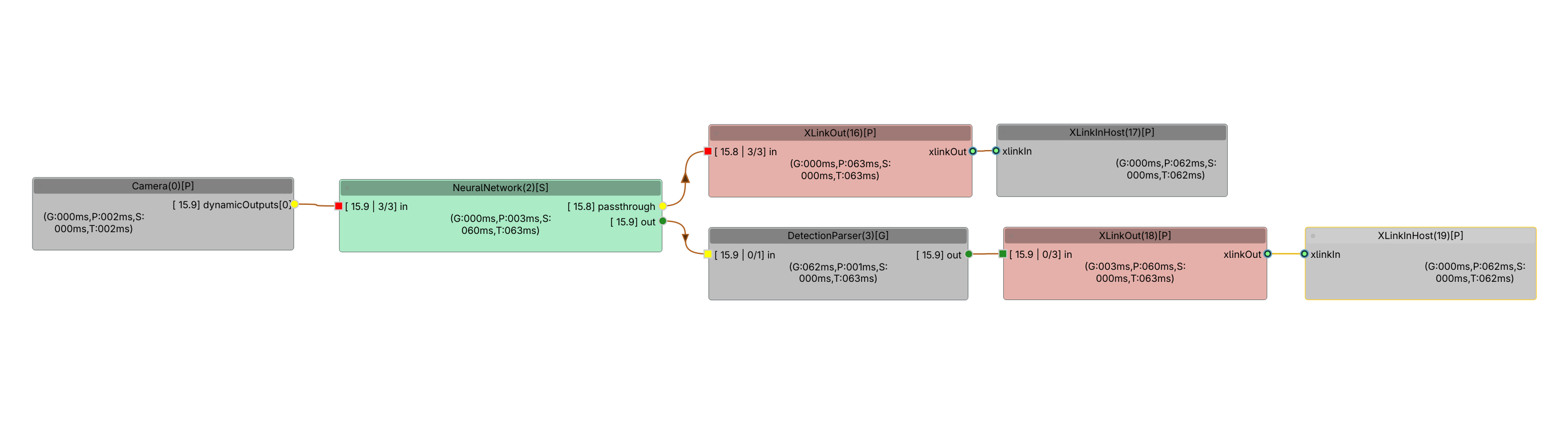
DepthAI v3.3.0 adds built-in pipeline debugging support, allowing developers to visualize and inspect running pipeline graphs using the depthai_pipeline_graph tooling. This makes it significantly easier to understand data flow between nodes and debug complex pipelines during development. Examples are available in both C++ and Python.
🧠 Neural-Assisted Stereo Fusion
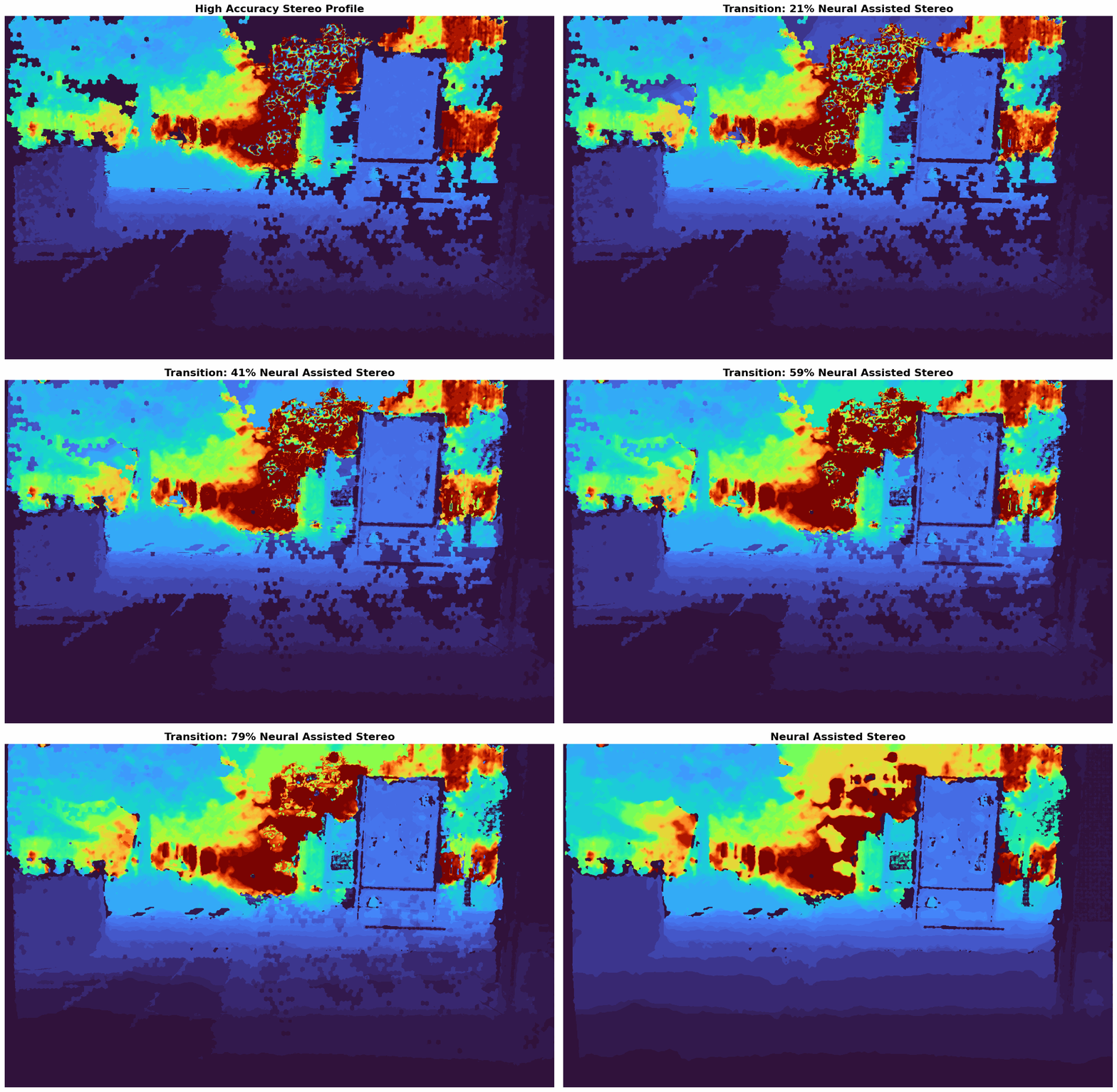
This release introduces the NeuralAssistedStereo node, which fuses classical stereo depth with neural depth internally. By combining traditional stereo algorithms with neural predictions, this approach delivers richer and more reliable depth maps across a wider range of scenarios. You can read more about it here.
🔌 Exposed XLinkBridges
For advanced host–device communication use cases, XLinkBridges are now exposed. This enables more flexible integration patterns and custom data routing, with examples provided in both Python and C++.
🏠 Housing Calibration & System Metrics (RVC4)
RVC4 devices gain support for housing calibration through the CalibrationHandler, improving pose and alignment workflows. In addition, a new SystemLogger node and expanded SystemInformation metrics make it easier to monitor device health and performance in real time.
🎯 Improved StereoDepth Presets (RVC4)
StereoDepth presets on RVC4 have been updated to provide better quality and fill-rate trade-offs, allowing developers to choose configurations that best match their application needs.
Miscellaneous Enhancements
• RemoteConnection now supports binary services and configurable callback thread counts, improving reliability and performance for remote control use cases.
• A new resize mode has been added to the build() method of NeuralNetwork, DetectionNetwork, and SpatialDetectionNetwork nodes.
• ImgFrame.setCvFrame() now supports more frame types, improving format compatibility.
• On RVC4, manual white balance is now supported, and dot projectors automatically turn off when pipelines stop.
• Temporal filtering has been added to the NeuralDepth node on RVC4, producing smoother depth output.
Bug Fixes & Stability Improvements
This release includes numerous fixes to improve stability and correctness across platforms:
• Fixed an SSD parser regression and added labelName support for keypoints and detections.
• Fixed file corruption when recording long H.264 videos using the Record node.
• On RVC4 Windows systems, Nagle’s algorithm was disabled to avoid latency spikes.
• Fixed a race condition in StereoDepth on RVC4 affecting left/right frame input handling.
• Corrected camera mapping issues on RVC4 custom boards.
• Fixed a rare MessageGroup cache coherency issue on RVC2.
• Removed a false warning in SpatialDetectionNetwork on RVC2 when input images were rotated.
Documentation
Here are the full release notes together with links to examples.
Follow the documentation pages to get a better understanding of how to use the new features.
Installation
To install or upgrade to DepthAI v3.3.0, run:
python3 -m pip install depthai==3.3.0
DepthAI v3.3.0 significantly improves observability, depth quality, and system introspection while continuing to refine the developer experience. We’re excited to see how these new capabilities help you build even more advanced spatial AI applications 🚀